What a Content Removal Policy Should Promise
A removal policy earns trust with four specifics: where to send a report, what counts as reportable, how long an acknowledgement takes, and what happens if the first answer is unsatisfactory. Anything vaguer is marketing. The platform documents two intake routes — a report control on each content page and the inbox [email protected] — and publishes both a removal policy and a separate complaints route, which is the structure a careful reader should be looking for.

Key takeaways
- Intake should not require an account: the platform accepts reports through a control on every content page and by email at [email protected].
- A removal route and a complaints route are different things, and the platform publishes both as separate pages.
- Provenance is documented separately in the 18 U.S.C. section 2257 statement, updated 8 Feb 2025, which states that the content is AI-generated text and depicts no real person.
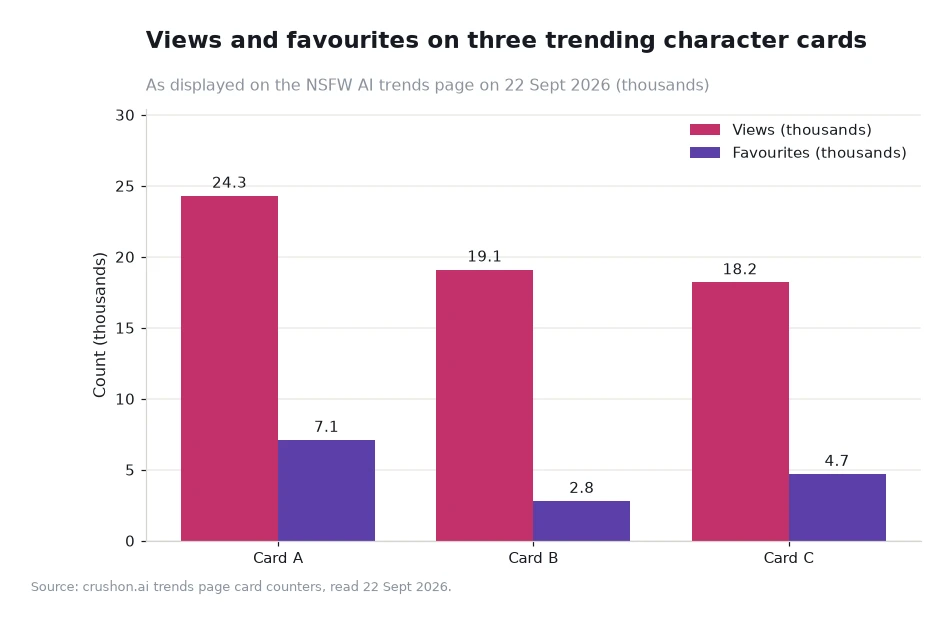
- Scale gives context: the busiest card read here shows 24.3M views against 7.1K favourites, and even a rare problem can be reached by a large audience.
Four things a removal policy must state
The intake route comes first. A policy that asks you to create or sign into an account before reporting has made reporting harder than using the service, which is the wrong way round. Two open routes are the standard to look for: a control attached to the content itself, and an email address that does not depend on being signed in. Both are published by the platform, with [email protected] listed as the reporting inbox.
Scope comes second. A policy should say what can be reported — content that breaches the operator's own community guidelines, material that misrepresents what the service is, an obvious error — and it should say plainly what falls outside it. The platform already publishes a limits note in its FAQ: some limitations apply under its content and community guidelines. That sentence is the scope statement, in miniature.
Timing comes third, and it is usually missing. A stated acknowledgement window, even a generous one, is worth more than an assurance of a thorough review, because a window can be measured and an assurance cannot. Escalation comes fourth: what to do when the first response does not settle the matter.
| Expectation | Should state | How to check it |
|---|---|---|
| Intake route | A control on each content page and a public email address | Look for a report control and for [email protected] |
| Scope | What is reportable and what is outside the policy | Read the content and community guidelines note in the FAQ |
| Timing | An acknowledgement window rather than a vague assurance | Check whether any interval is stated at all |
| Escalation | A separate complaints route for unresolved cases | The platform publishes a complaints policy page |
| Provenance | What the material on the service actually is | Read the 2257 compliance statement, dated 8 Feb 2025 |
Why provenance belongs in the same conversation
Removal is easier to reason about when you know what is being removed. The platform's compliance statement, updated on 8 February 2025, says the content is AI-generated text and depicts no real person, and that the site does not produce imagery or video of the kind a newcomer might assume. That matters for reporting because it sets the terms: a report is about generated text and a description, not about the likeness of anybody living.
Remove one common worry and reporting becomes easier still. Readers sometimes hesitate to report anything on an adult service because they assume a complaint implies an accusation about a real person. Crushon's own FAQ introduces the service as Porn Chat AI and answers four questions about what it is, how realistic the responses are, what restrictions apply and why to choose it — and the compliance statement settles the point that no real person appears in the material at all. Reporting is therefore a straightforward question about rules rather than about individuals.
Read the two documents together and the picture is coherent: a statement of what the content is, and a process for what to do when something breaches the guidelines.
Worked example: how rare a report should be
Put the ordinary case in numbers. An illustrative reader sending 40 messages a day writes 1,200 messages in a 30-day month. If one message in a thousand prompted a genuine concern — an assumption about frequency, not a measured rate — that reader would face about 1.2 concerns a month, or roughly fourteen over a year.
Set that against the platform's published counters. The busiest card read for this article shows 24.3M views against 7.1K favourites, and the third shows 18.2M against 4.7K. Whatever the true rate of problems is, it is being multiplied by an audience in the tens of millions, which is exactly why a plain intake route and a documented escalation path matter more than a warm sentence about taking concerns seriously.
The practical takeaway from the arithmetic is not the assumed rate. It is that a report should be a routine action rather than a last resort, because even a rare event is expected across a large population, and processes are built for exactly that.
How to write a report that gets acted on
Be specific and be factual. Name the page, describe what is wrong in one or two sentences, and leave out your feelings about it — a decision-maker is looking for the guideline that has been broken, and the faster that is visible, the faster the review moves. If you can quote the exact wording that concerned you, include it.
Keep a copy of what you sent, with the date. If the first response does not resolve the matter, the escalation route is easier to use when you can point to the original report and the answer it received. The platform publishes a separate complaints page for precisely that second step.
Finally, check the design of the service before you report something as a fault. The ai porn chat page states the three properties the operator advertises — customisable characters, a private and secure environment with state-of-the-art encryption, and natural adaptive responses — and its FAQ answers the obvious questions about realism and restrictions. A report that engages with those published claims is much harder to dismiss than one that does not.
Frequently asked questions
Do I need an account to report content?
Two routes are published: a report control on each content page, and the email address [email protected]. The email route is the one that does not depend on being signed in.
What is the difference between removal and complaints?
Removal covers content that breaches the guidelines. Complaints cover everything else, including disagreements about a decision, and the platform publishes it as a separate process.
Should I expect an instant response?
Expect a process rather than a reply time, and read the policy for any stated interval. If none is published, that absence is itself useful information about the operator.
Judge the policy, not the promise
A good removal policy can be read in five minutes and leaves four questions answered: where to report, what counts, how long an acknowledgement should take, and what to do next. If a service cannot answer those, the rest of its reassurance is decoration.
Bookmark the removal and complaints pages when you sign up rather than searching for them later, and check the publication date whenever you return to them. Policies change, and a date is the one part of a policy that tells you whether your earlier reading still applies.
Data and sources: the report route and inbox described on the content removal policy page[1], the escalation route published as a complaints policy, and the 2257 compliance statement dated 8 Feb 2025. Trend counters were read on 22 Sept 2026; the concern-rate figure is an illustrated assumption rather than platform data. Intended for adults 18 or older; read 22 Sept 2026.