A Percentage Without a Base Is Not a Price
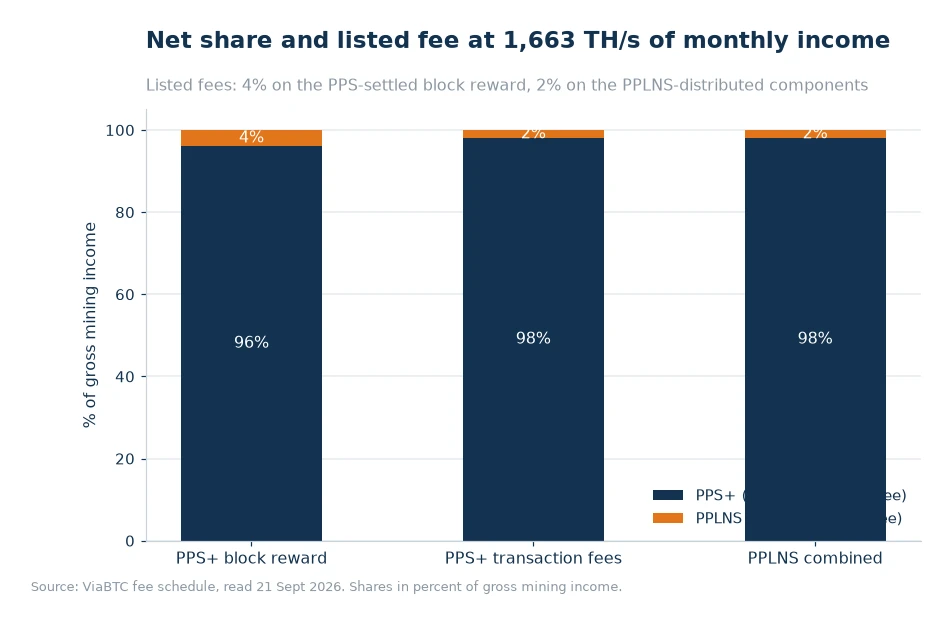
At 1,663 TH/s the pool produces $63.18 of gross income a day at $84,692 per BTC. The listed 4% on the PPS-settled block reward comes to $2.53 of that, while the listed 2% on PPLNS-distributed components comes to $1.26. Two rates, two different bases, and a single headline number that hides both.

Key takeaways
- At 1,663 TH/s, gross income is $63.18 a day and the listed 4% on the block reward equals $2.53.
- A fee percentage only means something once the base it applies to and the settlement method are named.
- PPS+ settles hourly; PPLNS settles six confirmations after a block over a five-round window.
- Convert every quote to net dollars per day at your own hashrate before comparing.
Two numbers that do different jobs
PPS+ is the default scheme on ViaBTC, and it splits income into two parts with separate treatment. The block-reward portion is settled per share at a listed 4%, paid hourly against current difficulty. The transaction-fee portion follows PPLNS logic at a listed 2%. Reading those two figures as a single deduction is a common mistake in pool comparisons, because the 4% never touches the fee-derived slice and the 2% never touches the subsidy slice.
PPLNS works on one base instead of two. Block reward and transaction fees are combined, distributed by share over the last five difficulty rounds, and charged a listed 2%. The percentage looks friendlier, and on a long enough horizon it often is, but the miner now carries pool luck and the timing of block discovery. The scheme is cheaper on paper and noisier in the wallet.
Why the base matters more than the percentage
Picture two offers: one advertises 1% and one advertises 3%. Without knowing what each charges 1% or 3% of, the comparison is empty. A percentage applied to a gross figure that already excludes transaction fees is a different number from one applied to a total that includes them. A percentage charged on every block found is different again from one charged only on the subsidy. The base decides the answer; the percentage only scales it.
This matters at every size. At 1,663 TH/s a day's gross is $63.18, so one percentage point of the whole thing is about 63 cents. One point of the block-reward-only base is a slightly smaller number, because the fee slice is excluded. Over a month those cents become tens of dollars, and over a year they become a line item worth negotiating. Nobody can negotiate a number they cannot locate on the statement.
Timing is a cash-flow decision
PPS+ credits arrive hourly against current difficulty, which means the balance moves in small, predictable steps. PPLNS credits arrive after a block reaches six confirmations, and the size of each credit depends on the shares the miner contributed inside the last five difficulty rounds. Two miners with identical hardware can therefore see different daily totals for a week without either pool doing anything wrong.
For an operation paying a power bill on the twentieth of the month, that difference is practical rather than theoretical. Hourly settlement makes the incoming line smooth and the outgoing line easy to schedule. Block-based settlement produces lumpier receipts and a longer wait before the first one. Choose the scheme whose timing matches the obligations, then compare the cost.
Normalising three quotes into one column
The only fair comparison is net dollars per day at your own hashrate, computed with the same inputs for every candidate. Write down four things for each: the gross daily income at your TH/s, the base each rate applies to, the settlement timing, and any withdrawal charge. Then subtract every named charge from the gross and put the result in one column.
Two adjustments are worth making. First, express the result per terahash so offers at different sizes line up. Second, show the same calculation at a lower BTC price, because a scheme that only clears at today's $84,692 is a bet on the price rather than a fee schedule. Neither adjustment requires a forecast. Both expose which quote depends on favourable conditions.
What the listed rate leaves out
The ViaBTC Pool Fees schedule covers pool charges, not the rest of the operation. Power, cooling, hardware depreciation, repairs and the occasional replacement board sit outside it, and at small scale they dwarf the percentage. Withdrawal is one cost that does not appear: mining payouts on ViaBTC are zero-fee, so the coins leave the account without a transfer charge, which is a genuine difference against venues that clip a withdrawal fee.
Variance is the other omission. A PPLNS miner can have a flat week and a strong week with the same hashrate. That is not a fee, but it belongs in the same conversation, because smoothing it away is exactly what the higher block-reward rate under PPS+ buys. The listed 4% is the price of not carrying pool luck. Whether that price is worth paying depends on how much a lumpy receipt would disturb the rest of the budget, and the pool state view shows how the pool's own luck has recently run.
| Component | What the rate applies to | Listed rate | Credited | Luck sits with |
|---|---|---|---|---|
| PPS+ block reward | Subsidy per share | 4% | Hourly, current difficulty | The pool |
| PPS+ transaction fees | Fee-derived income | 2% | With the PPLNS window | The pool |
| PPLNS combined | Subsidy plus fees | 2% | Six confirmations after a block | The miner |
| Mining withdrawal | Coins leaving the account | Zero-fee | On request | Not applicable |
Worked example
Take 1,663 TH/s and price the two bases against each other.
- Daily issuance across all miners: 144 × 3.125 = 450 BTC.
- Divide 450 by 1.003 billion TH/s: 0.00000044865 BTC per TH/s.
- At 1,663 TH/s: 1,663 × 0.00000044865 = 0.00074611 BTC a day.
- Value at $84,692: 0.00074611 × 84,692 = $63.18.
- Treat the whole gross as the block-reward base and the listed 4% is 63.18 × 0.04 = $2.53 a day.
- The listed 2% on a PPLNS base of the same size is 63.18 × 0.02 = $1.26 a day.
- Difference between the two bases: $1.27 a day, or $38.10 over 30 days.
- Net under the 4% line: 63.18 − 2.53 = $60.65 a day, before power and hardware costs.
Frequently asked questions
Is PPS+ simply a 6% fee?
No. The listed 4% applies to the block-reward component and the listed 2% to the transaction-fee component, so the effective deduction depends on how much of the gross came from fees. At 1,663 TH/s that split yields $2.53 and $1.26 respectively at today's inputs.
Which scheme settles faster?
PPS+ credits hourly against current difficulty. PPLNS credits after a block receives six confirmations and distributes over the last five difficulty rounds, so the first payment arrives later and individual payments vary more.
Does a lower headline rate always cost less?
Only if the base is the same. A lower rate charged on a wider base can cost more than a higher rate charged on a narrow one, which is why every quote should be converted to net dollars per day at your hashrate.
Compare the net line, not the banner
Build the comparison as a spreadsheet with one row per candidate and one column for net daily dollars. The Profit Calculator fills in gross income at current difficulty and your hashrate; the schedule page supplies the rates and their bases. Then run it again with the price 20% lower. A quote that survives both passes is a quote worth discussing.
Keep the workings. When a statement arrives with an unexpected line, the ability to point at the base, the rate and the settlement rule is what resolves the query. A fee you can reconstruct is a fee you agreed to; one you cannot is a number somebody else chose.
Sources: ViaBTC fee schedule and calculator pages, both read 21 Sept 2026[1]. Figures used: 1,003 EH/s network hashrate, difficulty 132.76 T, 144 blocks of 3.125 BTC each day, BTC $84,692. Published 24 Oct 2026; all figures are arithmetic on those inputs.