Questions Importers Can Ask About Sourcing Hotel Lighting from China
Hotel lighting sourcing requires more than matching a fixture photo to a design board. Buyers need to confirm the exact luminaire, driver, optics, finish, controls, and installation conditions, then compare photometric evidence and safety documents for that configuration. A room mockup can expose glare, color mismatch, or control issues before a large project order.
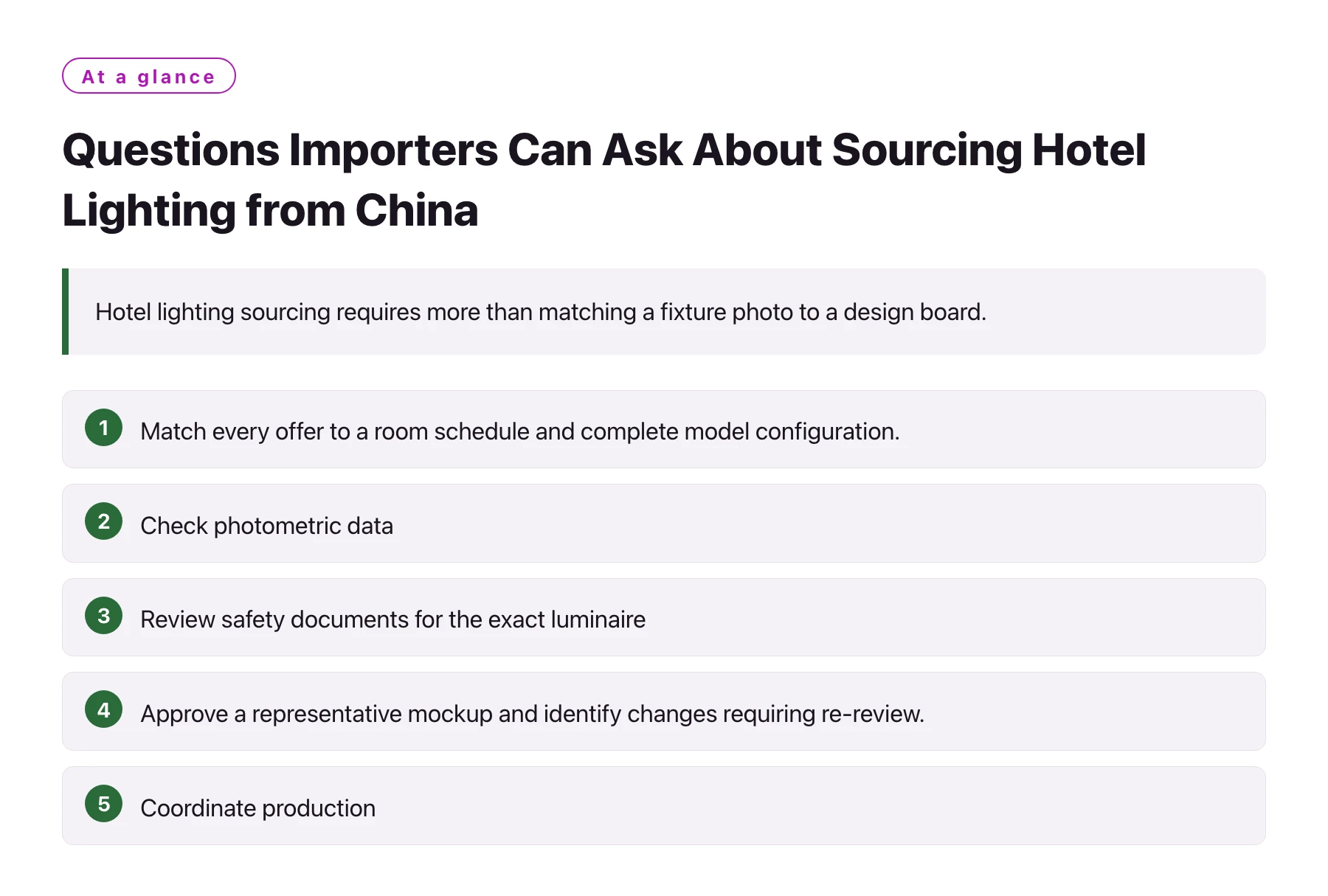
Key takeawaysMatch every offer to a room schedule and complete model configuration. · Check photometric data, color, dimming, control compatibility, and maintenance access. · Review safety documents for the exact luminaire, driver, and destination market. · Approve a representative mockup and identify changes requiring re-review. · Coordinate production, packing, spares, commissioning, and room handover.
Use a common room brief and product evidence matrix to compare supplier offers on the same basis.
1. What room and task is the light designed for?
Describe guestrooms, corridors, lobby, dining, meeting, or service areas. Include ceiling height, surface finish, daylight, operating hours, cleaning, and maintenance access. Note whether the fitting provides ambient, task, accent, or emergency light. Similar-looking products may serve different tasks.
Provide the reflected ceiling plan, mounting detail, control schedule, and finish references. Ask suppliers to identify assumptions that affect photometry, glare, spacing, dimming, or installation. Resolve unclear design inputs before comparing price.
2. Which exact luminaire configuration is quoted?
Request a complete bill of materials: housing, LED module, driver, optics, trim, finish, mounting hardware, connectors, control gear, and accessory codes. Record model and revision. A family name may conceal different output, beam, driver, color, or control variants.
Ask which components are replaceable and whether a substitution changes test reports, photometric data, warranty, or commissioning. Put exact codes on the sample and quote so that approval cannot drift to a superficially similar option.
3. What photometric and visual evidence is available?
Request a photometric file or report for the exact optic and output. Compare distribution, delivered output, beam, uniformity, and glare under project conditions. For decorative fittings, inspect both lit and unlit appearance and assess finish under the hotel’s actual materials and light scenes.
Define color temperature and acceptable consistency with units and tolerances. Check output and color on the physical sample using a suitable measurement method if required. Broad descriptions such as “warm white” do not give the project a repeatable limit.
4. Have the controls been tested together?
Test the offered driver with the project dimmer, controls, sensors, gateway, and representative wiring. Check startup, low-end stability, scene changes, audible noise, flicker concerns, fade, and recovery after power loss. Record control model and firmware where relevant.
Ask the controls specialist to approve compatibility and commissioning settings. A generic product compatibility sheet may not prove the proposed combination works in the hotel installation.
5. What safety evidence matches this product?
IEC 60598-1:2024 sets general safety requirements and tests for luminaires, covering topics including classification, marking, mechanical and electrical construction, and photobiological safety. Ask the qualified compliance owner to confirm the applicable edition, product-specific part, and destination rules. [1]
Request reports that identify luminaire, driver, LED module, construction revision, market, lab, and test scope. Check labels, wiring diagrams, installation instructions, and ingress claims where relevant. Do not accept a document for a different model as automatic evidence for the quoted unit.
6. Can the supplier provide a representative mockup?
Choose a representative room or test bay with the planned ceiling, finishes, mounting, controls, and daylight. Install the complete quoted fitting and note height, spacing, aiming, control scene, and sample identity. Include design, operations, maintenance, and project teams in review.
Record agreed visual findings, measurements, remaining questions, and approval owners. If optics, output, color, control, or finish changes, state whether another mockup or test is required. A sample shows only its own configuration and review conditions.
7. How will production match the approved sample?
Ask how model codes, driver lots, LED modules, finishes, and controls are checked during production. Review the supplier’s inspection records and process for preventing mixed variants. State which functions, dimensions, labels, and appearance details will be checked before packing.
Require written notice of a component, factory, or process change. Define re-approval triggers and link the final order to the accepted submittal revision. Keep photos and sample records available to receiving and installation teams.
8. What is included in delivery and service?
Confirm carton protection, model labels, accessories, spare drivers or modules, installation instructions, warranty, replacement lead time, and after-sales contact. Ask how the supplier will support commissioning faults and how parts are identified after installation.
Compare complete costs for lighting, controls, accessories, inspection, shipment, and likely replacement parts. Ensure quote exclusions and delivery assumptions are explicit. Coordinate site receiving with room installation sequence.
9. Which questions should the buyer ask before award?
Ask who designed and manufactured each item, which factory and subcontractors are involved, what reports cover the exact model, what variations are proposed, and what remains pending. Ask which person can approve technical deviations and what evidence will accompany each batch.
Buyers considering hotel lighting sourcing can compare supplier responses using the room schedule and an agreed evidence matrix. Retain qualified design and compliance review, and make release contingent on the exact approved configuration and project documents.
Sources
Frequently asked questions
What should a hotel lighting sample include?
Request the exact luminaire, LED module, driver, optic, trim, finish, controls, accessories, labels, and documents included in the quotation.
Should the buyer conduct a room mockup?
Use one when appearance, glare, controls, or maintenance materially affect project acceptance. Record conditions and the models it covers.
Can a supplier substitute a driver after approval?
Only after written technical review because a driver change can affect dimming, safety evidence, performance, warranty, and serviceability.
What documents should accompany hotel lights?
Check photometric data, wiring and installation instructions, product labels, applicable test reports, warranty, and control compatibility evidence.