Developing Fragrance for Middle East Markets: What Changes
A fragrance line built for a European department store and one built for a Gulf market are not the same product with different packaging. The materials shift, the format shifts, and the way the product is worn and gifted shifts with them. None of this is mysterious, and none of it can be handled by adding oud to an existing formula. It has to be in the brief from the beginning.
Key takeaways
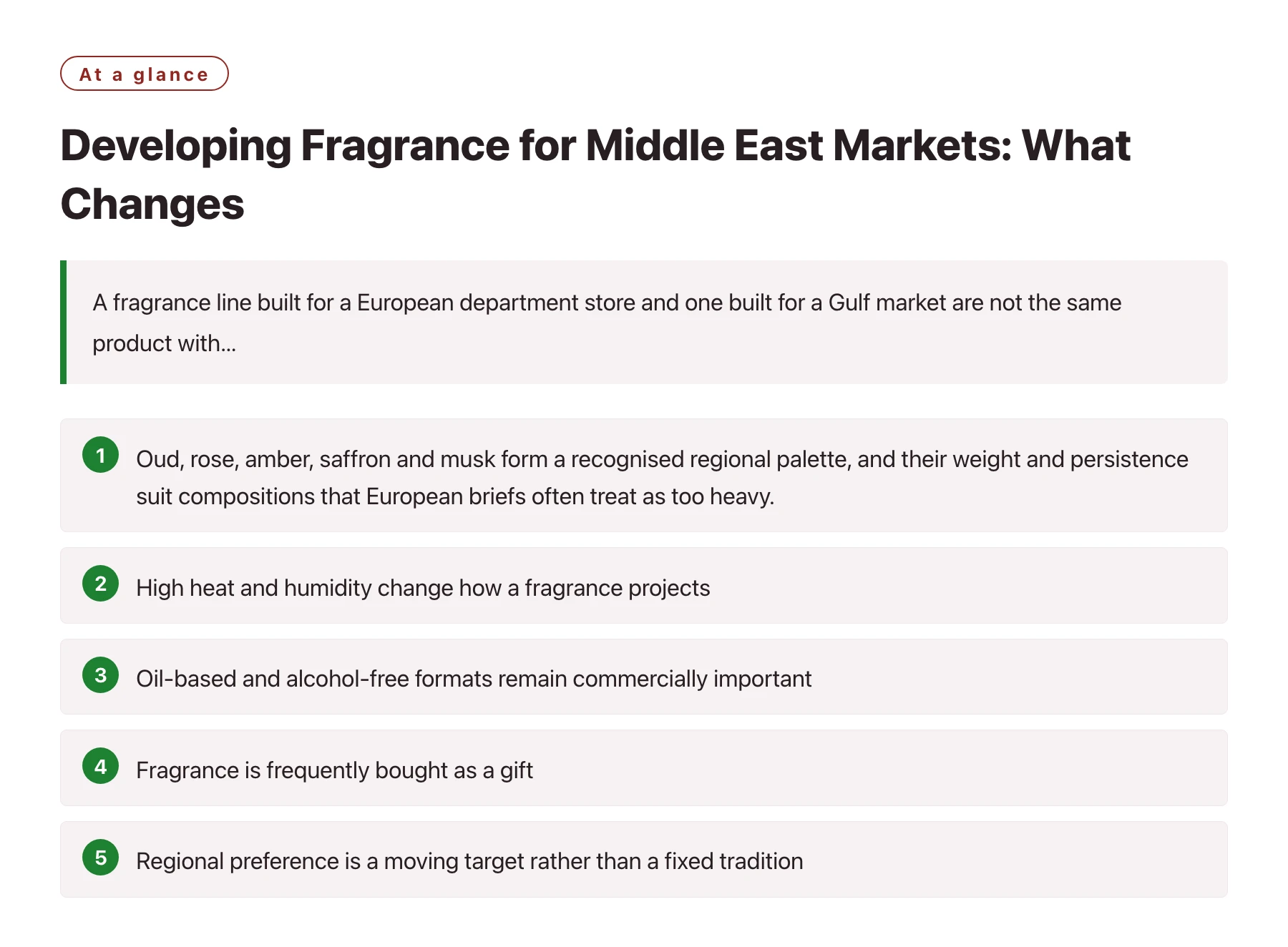
- Oud, rose, amber, saffron and musk form a recognised regional palette, and their weight and persistence suit compositions that European briefs often treat as too heavy.
- High heat and humidity change how a fragrance projects, so a formula that reads well in a cool climate can feel overwhelming in a warm one.
- Oil-based and alcohol-free formats remain commercially important, and they change the carrier, the applicator and the way performance is evaluated.
- Fragrance is frequently bought as a gift, which makes the outer pack, the closure and the presentation part of the product specification rather than an afterthought.
- Regional preference is a moving target rather than a fixed tradition, which is why consumer research on beauty and personal care is worth following alongside internal sales data [1].
Every export project runs into the same early assumption: that a successful product at home will be successful in a new market once the language on the carton is changed. In fragrance, that assumption fails more often than it holds, and the reason is practical rather than cultural.
Environment, wearing habits and ritual all feed back into the formula. A composition designed to be refreshed during a cool working day is doing a different job from one designed to sit on skin through an evening in high heat, and the same juice performs differently in each setting.
This article looks at what specifically changes when a line is developed for Middle East markets, and how to structure the work so those changes are deliberate.
How regional preference reaches the product brief
| Product dimension | Common regional expectation | What it changes in development |
|---|---|---|
| Olfactive weight | Rich, resinous and long-wearing compositions are widely appreciated | Base materials carry more of the composition, so the opening needs to lead into them deliberately |
| Signature materials | Oud, rose, amber, saffron, musk and incense recur across the market | Material cost rises sharply for oud and rose accords, so the cost model has to be built early |
| Format | Oil-based roll-ons, concentrated attars and sprays all sell alongside each other | The carrier and applicator change, which changes how performance is tested |
| Alcohol content | Alcohol-free options matter to a meaningful share of buyers | The carrier system is rebuilt, and stability testing has to be repeated for the new base |
| Presentation | Gift-giving means the box, closure and finish are part of the purchase decision | Outer packaging moves from protection to specification, with its own cost and lead time |
| Reapplication | Layering and reapplying through the day are common | The formula is judged on how it layers with others, not only on how it wears alone |
Read the third column as a list of development tasks rather than a list of preferences. Every row converts a market habit into an engineering consequence: a carrier change, a stability test, a cost line or a packaging specification. Briefs that name the habit without naming the consequence leave the factory to guess.
Why heat and humidity change the formula
Temperature changes how quickly aroma materials leave the skin, and humidity changes how they are perceived. The result is that a composition can feel noticeably stronger in a warm, humid environment than in a cool, dry one.
This is a development variable rather than a marketing one, and it should be tested rather than assumed.
Projection and closeness behave differently
In high heat, top notes lift faster and base materials diffuse more readily. A formula that felt balanced on a cool day can feel loud within minutes, which is why some compositions are deliberately built closer to the skin for warm markets.
The practical approach is to evaluate candidates at elevated temperature rather than at room temperature, and to compare how the composition reads at the thirty-minute and three-hour marks.
Oil-based formats need their own testing
An oil-based roll-on behaves differently from an alcohol spray: it releases more slowly, sits closer to the skin and interacts with the carrier over time. Stability testing done on an alcohol base cannot simply be carried over.
Because the format changes what the customer experiences, it is worth deciding the carrier before finalising the formula rather than adapting the formula afterwards.
Structuring a development project for Gulf markets
- Start from the format, not the note listDecide whether the line includes spray, oil roll-on or both, because the carrier decision constrains the formula and the stability programme.
- Build the cost model around the signature materialsOud and rose accords are the most expensive part of the brief, so fix a cost ceiling before the first sample rather than after it.
- Test at warm temperature and high humidityEvaluate the dry-down in conditions closer to the market, and check how the composition reads after several hours in that environment.
- Confirm the restricted-material position earlyMaterials used at high dosage consume their allowances quickly, so confirm the regulatory position before the formula is frozen [2].
- Design the pack as part of the productTreat the box, insert and closure as specification items with their own tolerances, because they carry much of the gifting value.
- Verify stability in the destination climateTest filled units through the temperature cycle they will actually experience in storage and transport, not only in a controlled laboratory.
Presentation and gifting as a specification
In markets where fragrance is commonly given as a gift, the purchase decision includes the pack. That makes presentation a technical requirement with tolerances, costs and lead times rather than a decorative finish applied at the end.
Two aspects cause the most surprises in production.
A gift pack has more components than a bottle
Insert, sleeve, ribbon, outer box and sometimes a bag are each a separate component with its own tooling, minimum order and assembly step. Each one also has to be inspected for fit against the bottle it was designed around.
The practical discipline is to treat the assembled pack as the unit under test. Testing the bottle alone tells you nothing about whether the insert holds it in place through a container journey.
Storage conditions are part of the design brief
A filled unit may sit in a warehouse, a shop window or a car. Adhesives, coatings and closures behave differently under sustained heat, and a finish that looks flawless in a sample room can lift or discolour in storage.
Ask what temperature the components were qualified for and whether the finished pack was tested as a whole.
Regional expectations also evolve rather than staying fixed, and fragrance houses increasingly organise their creative work around regional market segments for that reason [3]. Manufacturers that serve several regions tend to publish how they structure that work; the scope a house describes on the Xuelei website, for example, is a reasonable reference point for what a full-service fragrance manufacturer normally covers across export markets.
The most common mistake in an export fragrance project is commissioning one product for every market and then discovering that it satisfies none of them. A formula optimised for a cool climate and one optimised for high heat are genuinely different products, and the difference starts with the carrier and the base rather than with a top note. If the budget only allows one development, decide which market it is for and treat the others as adaptations that will need their own testing. That is a smaller commitment than building a single compromise product and finding out at the point of sale.
Sources
- Mintel Press Centre —— Mintel's press releases on consumer and beauty market research, including fragrance and personal care trend reporting.
- IFRA Standards Library (International Fragrance Association) —— The IFRA Standards Library lists the restrictions the fragrance industry applies to individual fragrance ingredients, based on safety assessments; it is the reference point for compliant fragrance formulation.
- Givaudan —— One of the largest fragrance and flavour houses; public material on fragrance creation, ingredient portfolio and market segments.
Frequently asked questions
What fragrance materials are most associated with Middle East markets?
Oud, rose, amber, saffron, musk and incense recur most often, usually in rich, resinous compositions built for long wear. Material cost is a real constraint, because oud and rose accords are among the most expensive elements in a formula, so the cost ceiling belongs in the brief.
Do I need an alcohol-free version for Gulf markets?
Not necessarily for every product, but oil-based and alcohol-free formats are commercially important enough that most lines include one. The change is not only the carrier: stability testing, the applicator and the way performance is evaluated all have to be reworked, so decide the format early.
Why does a fragrance smell stronger in a hot climate?
Higher temperatures accelerate evaporation and diffusion, so top notes lift faster and base materials project more readily. A composition balanced in a cool climate can feel loud within minutes in high heat, which is why evaluation at elevated temperature is part of developing for warm markets.
How important is packaging for these markets?
It carries much of the purchase decision where fragrance is bought as a gift. That makes the insert, closure, outer box and finish specification items with their own tolerances and lead times. Test the assembled pack, not just the bottle, and confirm the components were qualified for storage at high temperature.
Can one formula serve several regions?
It can serve as a starting point, but a single formula rarely satisfies markets with different climates and wearing habits equally well. If only one development is possible, choose the primary market and plan separate stability and performance testing for each additional market you enter.